
ROAD TRAFFIC LAW
Your licence, your job, your life on the road — all on the line
Tell us what happened in a free initial call, and we'll start to work on the strategy to save your licence
THE SITUATION YOU’RE IN
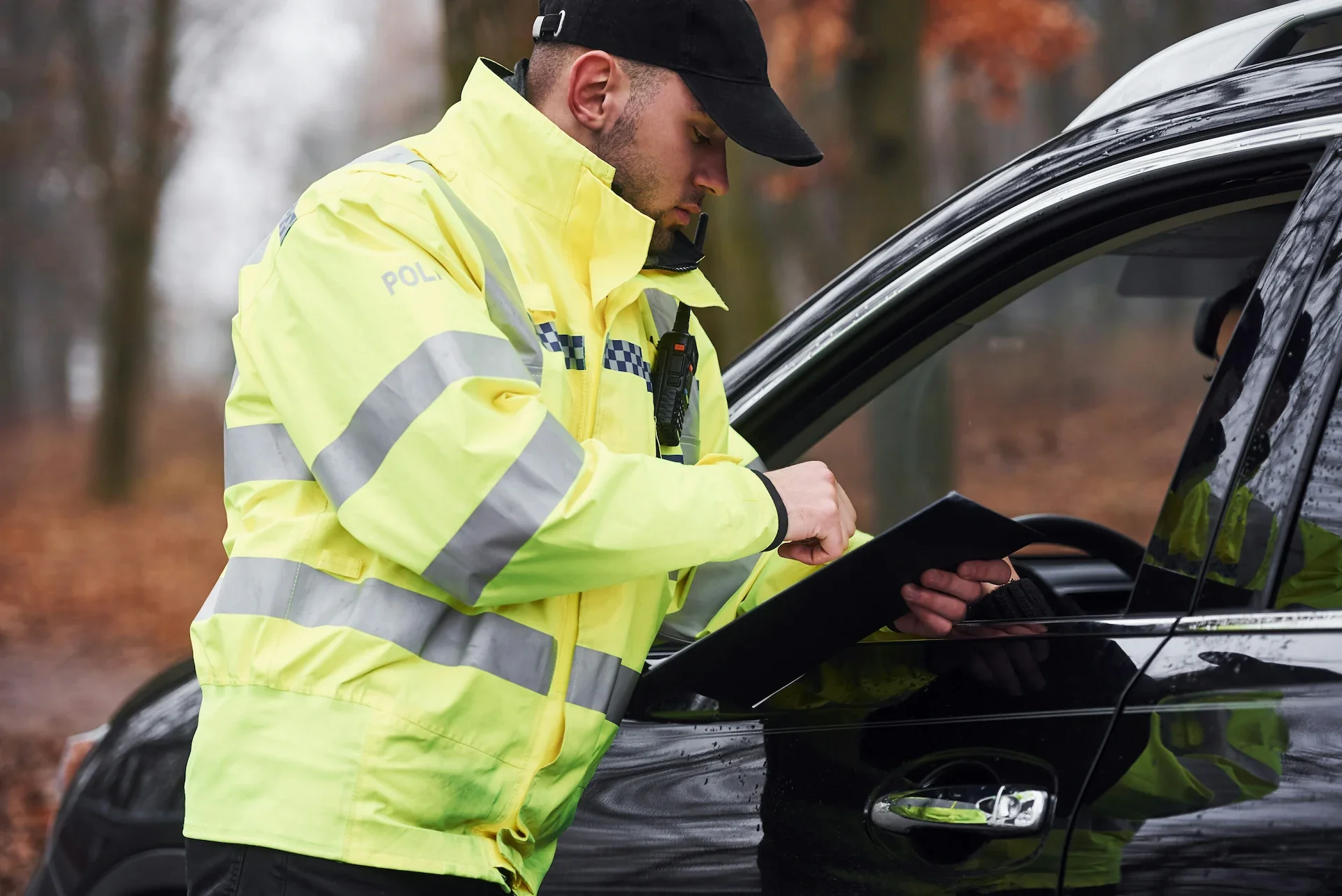
A blue light in the mirror
A citation for careless driving after an accident that happened in a heartbeat. Road traffic offences are the most common prosecutions in Scotland — and for most people charged, it's their first contact with the criminal courts.
The stakes are rarely "just points." Lose your licence and you may lose your job, your ability to get the kids to school, your business, your independence. That's why we treat every road traffic case as a livelihood case.
We defend drivers in courts right across the whole of Scotland. Our aim: To keep your licence.
ROAD TRAFFIC LAW
Your licence is your livelihood. Don’t risk it without advice
-
For most people, losing their licence isn’t an inconvenience — it’s losing the ability to get to work, run the family, or do the job that pays the bills. Yet many people walk into court for a driving offence with no advice at all, plead guilty to the first thing put to them, and lose their licence when they didn’t have to.
Before you do anything, speak to us. Often there is far more that can be done than people realise — and the time to find that out is before you’re standing in front of the court, not after.
-
We defend and advise on the full range of road traffic matters, including:
• Drink and drug driving — including failing to provide a specimen
• Speeding — including motorway and high-speed cases
• Dangerous and careless driving
• Driving without insurance
• Failing to stop or report an accident
• Totting up — where penalty points threaten a ban
• Mobile phone and construction-and-use offences
Whether you intend to plead guilty or not guilty, the outcome is rarely as fixed as it first appears — and good advice can be the difference between keeping your licence and losing it.
-
Even where an offence is admitted, a ban is not always inevitable. Depending on the circumstances, there may be arguments to keep you driving.
-
Where a totting-up ban would cause hardship beyond the ordinary inconvenience of losing a licence, the court can decide not to disqualify. This is a skilled argument to run, and running it well takes preparation and experience.
-
In certain cases, there may be reasons connected to the offence itself that allow the court to reduce or avoid a penalty.
-
How your case is presented to the court genuinely matters, and can directly affect the outcome.
These arguments succeed or fail on how well they’re prepared and presented. That is exactly where having the right solicitor pays for itself.
-
The single biggest mistake people make is waiting — or dealing with it themselves — and only seeking advice once the damage is done. The earlier we’re involved, the more options you have. A first conversation costs you nothing but a phone call and could save you your licence.
-
If you’ve been charged with a driving offence, or received a court citation, call us before you do anything. We’ll tell you exactly where you stand, what can be done, and what it will cost.
Speak to a solicitor — 01389 756 785
WHAT WE DO
The offences we defend
-
This is a serious charge. The prosecution must prove that the manner of driving fell far below the standard of a competent and careful driver. You do not necessarily need to have had an accident for this charge to arise but normally the prosecution would have to establish a potential danger or that your driving was so bad that your posed a danger to yourself or indeed other drivers.
The penalties are severe. If convicted, you face a ban of a minimum of 12 months as well as probably having to take an extended driving re-test. You would also be likely to receive a large fine. There is no upper limit and a custodial sentence of up to two years in jail is available for the most serious of offences.
Whether your driving falls under this section of the Act is a matter of the particular facts and circumstances of your case. We can assist you in persuading the Court to apply the correct test and take into account all relevant factors, including the road conditions, the expertise of the person making the allegation of dangerous driving against you and the conduct of the other drivers at the time.
Very often the evidence of ‘dangerous driving’ comes from police officers. We utilise the expertise of independent road traffic experts from whom evidence can be led on your behalf to support your position.
The lesser offence of careless driving is an implied alternative to a charge of dangerous driving where it is not accepted after evidence is heard that a charge of dangerous driving has been made out. This is important since a charge of careless driving does not carry an automatic disqualification of 12 months. Input from an independent Road Traffic Expert, often be utilised to persuade the prosecution to accept a plea to careless driving instead of dangerous driving thus saving your driving licence.
-
Careless driving is becoming a more common charge featuring in the courts and can be found under Section 3 of the Road Traffic Act 1988. It will normally be alleged that you have been driving in a careless or inconsiderate manner or driving without due care and attention. It must be proved by the prosecution that your driving fell below the level expected of a careful and competent driver. They must do so by proving this beyond reasonable doubt.
The penalties for careless driving are wide. They range from 3 penalty points and a fine to disqualification.
Defences available to drivers include the circumstances at the time the driver was aware of and the specific reasons for the driving. A thorough investigation must be made by the defence to test the prosecution’s case.
It is therefore vitally important that early expert legal advice is taken.
-
Drink Driving is a serious offence carrying severe penalties. Best case scenario, on being convicted of Drink Driving you will be fined and disqualified from driving for 12 months. Worst case, depending on the level of alcohol in your system and/or whether you have previous convictions for the same type of offence you could receive a prison sentence and a much more lengthy period of disqualification.
If you have a previous drink driving conviction within ten years of the current one the minimum ban is 3 years. You could also lose your car if the court orders it to be seized and forfeited. It is therefore extremely advisable that if you find yourself charged with this that you contact us immediately to discuss the best way of dealing with this for you. This initial consultation will always be free of charge.
The Drink Drive limit was lowered in Scotland. The current amount of alcohol you are allowed to have in your system whilst driving is as follows:
– 22mg of alcohol in 100 ml of breath
– 50mg of alcohol in 100ml of blood
– or 67 mg of alcohol in 100ml of urine.
This change in the law means that it is now possible to be over the limit simply by drinking a glass of wine or a pint of beer.
-
Driving without a valid driving licence appropriate to that class of vehicle or driving with a provisional licence without the “appropriate person” being present and or displaying “L” plates is an offence under the Road Traffic Act. If found guilty of this you will be fined and receive either 3-6 penalty points or a discretionary ban.
Normally this will invalidate any insurance policy as well. It is therefore likely that a charge of driving without an appropriate licence will lead to an additional charge of driving without insurance. This however may not be the case and any insurance policy should be scrutinised closely.
In respect of Provisional Drivers, an appropriate person is any person over 21, who has held a valid driving licence for a minimum of 3 years.
-
It is an offence under section 41D of the Road Traffic Act 1988 to drive a motor vehicle while using a hand-held mobile telephone or other hand-held interactive communication device, contrary to regulation 110 of the Road Vehicles (Construction and Use) Regulations 1986. The particular facts and circumstances of each case are fundamentally important when assessing the strength of the defence of your case.
The regulation is considerably wider than most drivers realise. Since it was amended in March 2022, the offence is no longer confined to calls and texts: almost any use of a hand-held device while driving is caught, including scrolling, selecting music, taking a photograph or checking a map. Limited exceptions remain — hands-free use, a genuine 999 call in an emergency where it is unsafe or impractical to stop, and contactless payment while the vehicle is stationary.
A conviction carries six penalty points and a fine. For anyone who passed their test within the previous two years that is enough to revoke the licence, and for many other drivers it is enough to bring them within reach of a totting-up disqualification.
Very often the prosecution case will simply consist of two police officers stating that they clearly saw you either engaged in a telephone call or otherwise using a hand-held device while ‘driving’.
Critical to a successful defence of an offence of this nature is robust cross-examination of the two police officers and knowing what aspects of the prosecution case to target. It is therefore extremely important to seek early expert legal advice and we have had considerable success in defending these cases on behalf of our clients.
-
Given the massive increase in speed cameras and mobile speed measuring devices used by Police Scotland throughout the country, it is highly likely that most drivers in Scotland will receive a speeding ticket at some point in their lifetime.
This will usually be by way of either a fixed police camera which will take photographic evidence or from a hand held device operated by a police officer at the side of the road. A police officer can also claim that you have been speeding by utilising a calibrated speedometer within his/her own vehicle.
The prosecution must still prove the accuracy of the speed measuring device and a police officer must have followed the correct procedure before you can be convicted of any speeding offence. That is why it is crucial that you contact us immediately to discuss your own particular situation in order that you can be properly advised.
You may simply be given a £100 fine and 3 penalty points and think that you should just pay it to save any further hassle or embarrassment. That is arguably what the ‘system’ relies on. It is of course entirely your decision. If you have no penalty points or are sitting on only 3 penalty points then there may be sense in that decision. But remember, accumulate 12 or more penalty points and you run the risk of losing your driving licence. Points can accummulate quickly and you should think carefully before simply accepting your ticket, 3 penalty points and your fine.
The speed measuring devices operated by the police are not 100% fool-proof. Things can go wrong with them. They are operated by humans, police officers, and human beings are of course capable of making mistakes and indeed often do in our experience. It is necessary that certain checks are completed before the accuracy of a device and hence its recorded speed can be relied upon. These machines have to be annually calibrated. They are required to go through various essential checks by the officers before utilisation and there should be annual calibration checks by the manufacturer to ensure they are still working properly.
Totting-up
If you accept you were speeding you can usually expect to receive between 3-6 penalty points and a fine. It is open to the court to disqualify you from driving, depending on the speed you were travelling at and the particular facts and circumstances of your case at the time. If it is a high speed then this is obviously more likely. It is very important to take advice in that regard before rushing to a decision to ‘get it over with’.
If you have points already on your licence there is a real risk that through the totting-up provisions you will be disqualified from driving if you accumulate 12 or more penalty points on your licence.
Importantly, however, a driver can often still keep his driving licence by recourse to special reasons which can be explained to the court during a separate court hearing.
These special reasons often involve putting extenuating circumstances for consideration before the Court whereby penalty points are not put on your licence although you have still been convicted of the offence. This can mean the difference between you keeping your licence and losing it.
That is why it is crucial that you contact us in order that we can advise you on your position and help you to keep your licence using our inside knowledge of the law and the Scottish Courts .
-
It is an offence to use or permit another person to use a vehicle without valid insurance in a public road or place. The penalty for doing so is a fine and 6-8 penalty points on your licence or a fine and a discretionary ban.
STRICT LIABILITY
Driving without insurance is a strict liability offence. This means that it is not a defence to say that you did not know you had no insurance. You may have special reasons for not having your licence endorsed with penalty points (see special reasons). However, the simple fact that you were not insured at the time of using the vehicle will normally be enough for you to be guilty of the offence.
EMPLOYEES' DEFENCE
There is a statutory defence available to employees. If they were driving the said vehicle during the course of their employment and had been led to believe by their employer that they were covered to do so by a valid policy of insurance. This is a defence to a charge of driving without insurance. The onus here is for the defence to persuade the court of this.
“USE”
It is important to note that it is not only an offence to drive a vehicle but also simply to be using it. Therefore, if the vehicle is parked in a public place or street you can be found guilty of using the vehicle without valid insurance. The prosecution do not need to lead evidence of the vehicle actually being seen driven.
“PUBLIC ROAD OR PUBLIC PLACE”
What is defined as a public place is not always straight forward either. It will usually depend on the degree of public access available.
CAUSING AND PERMITTING ANOTHER TO USE YOUR VEHICLE
If you cause or permit another person to use your vehicle without a valid policy of insurance allowing that person to drive the vehicle you will be guilty of an offence. The penalties for this are identical to that for if you were using the vehicle yourself. As the owner of the vehicle the onus is on you to ensure that anyone driving that vehicle is adequately insured.
Whatever your circumstances it is our experience that cases of driving without insurance are rarely straight forward. For that reason, seeking advice from a specialist is always advised.
-
If a registered keeper of a vehicle is required by police officers to provide the details of the driver of a vehicle at the time of an alleged road traffic incident, they are legally obliged to provide those details. Failure to do so will constitute an offence. This offence carries a penalty of 6 points on your licence and a fine. It is also at the court's discretion to disqualify you from driving.
This will commonly take place where the vehicle has been identified as being involved in a road traffic incident or violation but the driver is unknown (for example speeding detected on a speed camera).
NOTICE OF INTENDED PROSECUTION (S.172 Notice)
Normally what will happen is a notice will be sent to the registered keeper of the vehicle in question asking them to identify the driver of the vehicle at the time and place of the incident. Such a notice must be sent to you within 14 days of the date of the alleged offence. You will have 28 days to reply to this notice identifying the driver. If you fail to do this you will most likely be charged with failing to provide the driver details.
S.172 REQUIREMENT
The situation may also arise whereby two uniformed police officers come to your office or home and make what is known as a S.172 requirement. This is essentially a verbal form of the Notice of Intended Prosecution. Again you are under a legal obligation to identify the driver of the vehicle at the relevant time.
REASONABLE DILIGENCE
In many situations it will have been either yourself or a family member or friend using the vehicle, who you can easily identify. However, that is not always the case. If the vehicle is used by a number of persons it may not be possible to establish who drove the vehicle at the relevant time. If you are unable to identify the driver you will require to prove that you have used all reasonable diligence to identify the driver. Again the onus will be on the defence to establish this.
WE WOULD THEREFORE ADVISE THAT IF YOU FIND YOURSELF IN RECEIPT OF A NOTICE OF INTENDED PROSECUTION AND ARE UNABLE TO IDENTIFY THE DRIVER YOU SEEK OUR SPECIALIST ADVICE IMMEDIATELY TO DECIDE ON THE BEST WAY TO PROCEED.

THE NEXT STEPS
How we defend you
-
Tell us what happened. We'll give you a straight assessment — including when the smartest strategy is negotiation and mitigation rather than trial. Not every case should be fought; every case should be handled intelligently.
-
Detection device calibration, procedural compliance, disclosure timing, witness reliability, dashcam and phone data — road traffic prosecutions are technical, and technical cases have technical weaknesses.
-
We appear in Justice of the Peace and Sheriff Courts all across Scotland. Whether it's a trial, an exceptional hardship proof, or carefully prepared mitigation, you'll have an experienced court solicitor standing next to you.
OUR COSTS
What it costs
-
Clear fixed fees agreed before you start
Most road traffic cases are handled on clear fixed fees agreed before we start, so you know exactly where you stand. The initial call costs nothing and commits you to nothing.
WHAT TO DO NOW
What step to take next
01
Don't respond
To a fixed penalty offer or citation until you've taken legal advice — some responses can't be undone.
02
Note everything
While it's fresh: road conditions, weather, signage, what was said at the roadside.
03
Call us
On 01389 756785 for detailed guidance on your specific offence.
FAQ’S
Question? We have answers
-
Sometimes yes — but not before checking. If the points take you to 12, or you're a new driver, or a special reasons argument exists, accepting it could cost you your licence. One call will tell you.
-
If you reach 12 points, disqualification for 6 months follows — unless the court accepts that a ban would cause hardship beyond the ordinary, usually to others (employees, dependants, vulnerable people you care for). It must be properly evidenced and argued. This is core work for us.
-
Not always. Many matters can be resolved by written plea or by us appearing on your behalf. Where attendance is required, we'll prepare you and your case fully.
-
We defend drivers in courts across the whole of Scotland.

CONTACT US TODAY
Keep your licence. Call today
Get in touch with Jonathan Paul Solicitors
GET IN TOUCH
Let's talk about your case
A confidential first conversation, at no obligation. Tell us what's happened — we'll tell you exactly where you stand and what happens next.
CALL
HOURS
Monday-Thursday 9am - 5pm | Friday 9am - 4pm